
How to Find People Across Sammamish Records
A strong Sammamish people search starts with the fact that is least likely to have changed. A full name can open deed and court indexes. An address can reveal a parcel number, taxpayer name, and recorded transfer. A case number can lead straight to the right clerk. An old neighborhood name may unlock records created before Sammamish incorporated.
Use the narrowest official source first, then compare dates and roles rather than treating a single result as proof of identity.
- Search a full name and variants in King County Landmark and the Washington court index.
- For a known address, use Parcel Viewer, then eReal, then the deed recording number.
- Move a court hit to KC Script or KCDC Case Access for the current docket.
- For a deceased person, connect vital, probate, deed, obituary, and archive records.
- Ask the correct city, county, court, or state custodian when the needed file is not online.
Use records lawfully. Public access is not permission to stalk, harass, threaten, or expose protected personal information. Confirm identity and context with the record custodian.
Sammamish People Search Offices at Three Levels
Sammamish City Clerk keeps municipal records, while King County offices keep recorded land documents, property rolls, elections, and most local court files. Washington agencies hold statewide certificates, business entities, professional credentials, unclaimed property, and historical collections. The access rules and request details are organized on the Sammamish public records page.
King County Recorder
201 S Jackson St., Suite 204
Seattle, WA 98104
206-477-6620
King County Superior Court Clerk
516 Third Ave.
Seattle, WA 98104
206-296-9300
Police records belong with King County Sheriff, fire and EMS records with Eastside Fire & Rescue, and water records with the appropriate district. A request sent only to the city may be redirected for that reason.
Sammamish People Search Across Landmark's Three Eras
King County's Landmark system indexes deeds, liens, easements, covenants, powers of attorney, marriages, name-change orders, plats, and many other recorded instruments from 1976 forward. Search a person as “Last name, First name,” then limit by party role, document type, or date. Most images from August 1, 1991 forward are free watermarked copies.
| Search control | How it helps | Limit |
|---|---|---|
| Name and Party Type | Finds grantors, grantees, and other roles | Use name variants |
| Document Type | Limits deeds, liens, marriages, and more | One or many types |
| Begin and End Date | Narrows a likely event period | Optional |
| Parcel ID | Connects newer land filings | Weak before about 2002 |
| Recording Number | Retrieves a known instrument | Exact number works best |
The 1976 through July 1991 index often lacks an image, while the 1853 through 1975 grantor-grantee index remains on microfilm at King County Archives. A missing online image therefore is not a missing record.
The official Landmark screen shows the modes available for a Sammamish people search.
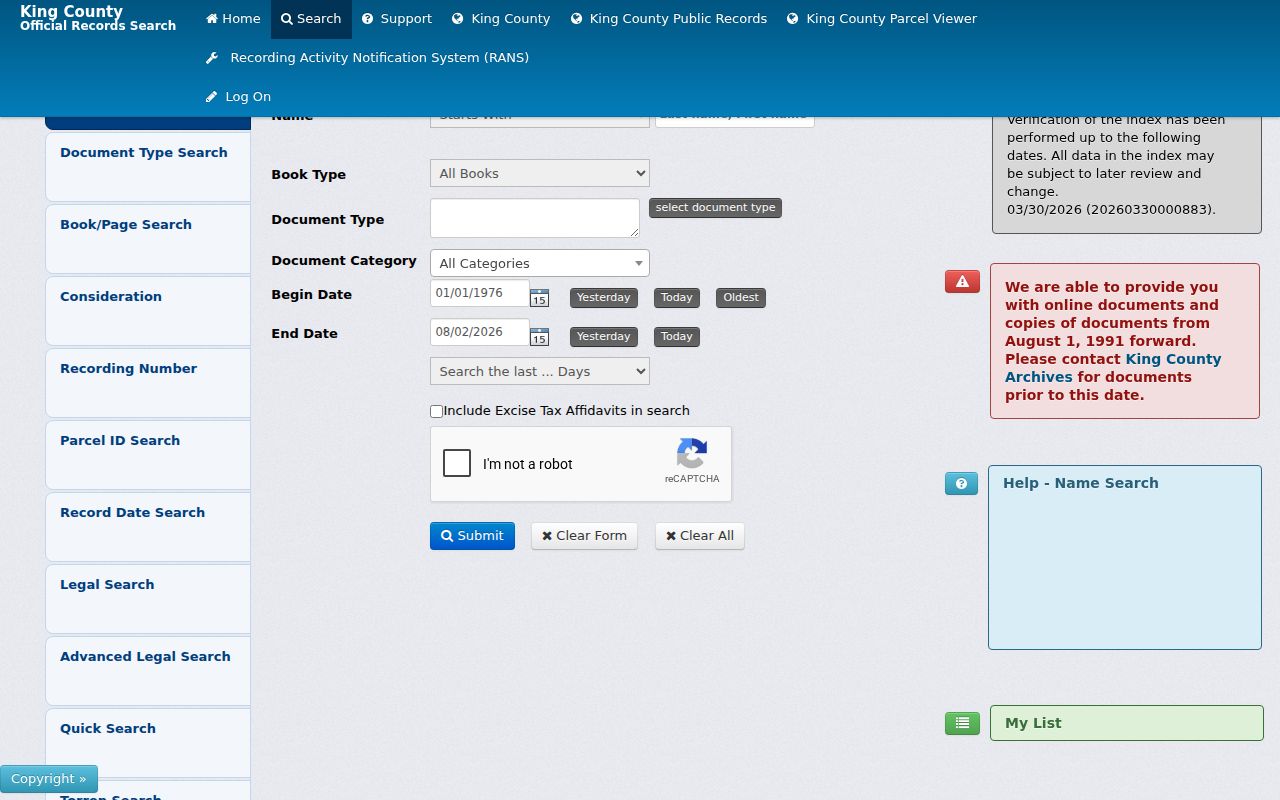
Its separate name, parcel, legal-description, book-and-page, and recording-number paths support different starting facts.
Note: Search older land instruments by party name, legal description, and approximate date when a parcel-only query returns no useful result.
Sammamish People Search From an Address
King County Parcel Viewer accepts an address, parcel number, or condominium name. Select the parcel on the map, open its Assessor Property Report, and note the 10-digit parcel number, taxpayer name and mailing address, legal description, transfer references, and assessed characteristics. The map boundary is approximate, not a survey.
The eReal property search is report-first and does not advertise a public owner-name search. It works from an address, parcel, or complex name. Follow its recording number back into Landmark to distinguish an assessment entry from the actual conveyance.
The official eReal interface illustrates the address-first route for a Sammamish people search.
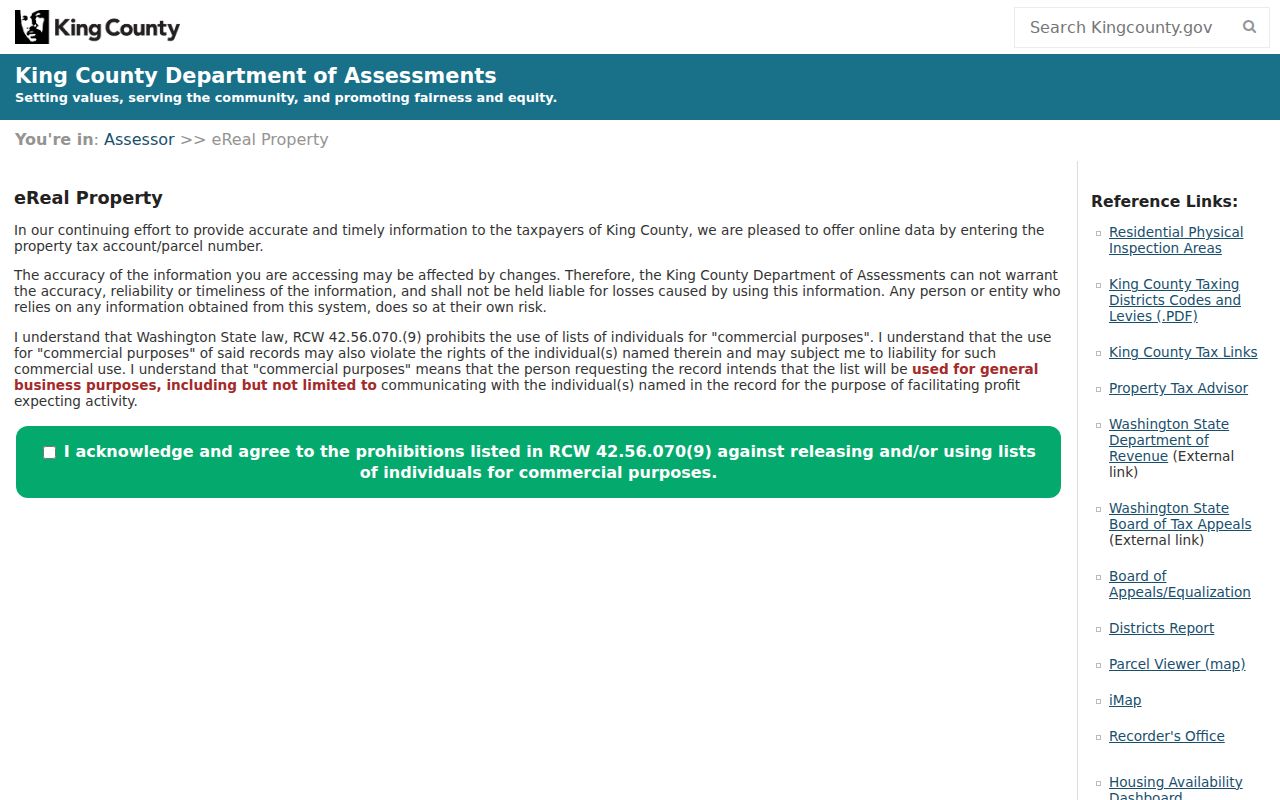
A taxpayer mailing address can be a useful lead, but it may belong to a trust, business, agent, or former owner and does not prove occupancy.
Sammamish People Search Through the Right Court
Sammamish has no separate municipal-court portal. King County District Court handles city ordinance, misdemeanor, infraction, and related municipal matters through its Bellevue facility. Sammamish civil and small-claims filings are assigned to Redmond. King County Superior Court handles felonies, probate, family matters, and larger civil cases.
| Record level | Search route | What follows |
|---|---|---|
| Statewide pointer | Washington Courts Search Case Records | Names, case number, court, and some docket links |
| King Superior | KC Script | Public docket, parties, hearings, and available documents |
| Sammamish municipal and District | KCDC Case Access | Case status, hearings, judgments, conditions, and document index |
| Federal | PACER and Western District clerk | Federal dockets and documents |
The statewide search requires first and last name plus CAPTCHA in person mode; middle name is optional. Odyssey Portal excludes King and Pierce Superior Courts and all limited-jurisdiction courts, so it is not the Sammamish destination. Sealed, adoption, and protected juvenile material stays unavailable, while full identifiers are redacted.
Sammamish People Search for Heirs and Probate
A deceased owner's trail can join several public sources without assuming that any one index tells the whole story. Start with a parcel or deed to establish the recorded owner. Search KC Script for a probate case and identify the personal representative, filing date, and docket entries. Then compare a death record, obituary, later deed, or recorded transfer-on-death instrument.
This is a practical human use for a Sammamish people search: locating relatives or understanding who has authority in an estate. A docket proves that a case and filing exist, not that every statement in a petition is true. Restricted family details and sealed documents remain with the clerk.
Docket: the chronological index of events and filed items in a court case. It is not always the complete document set.
Sammamish People Search With Vital Records
Washington Department of Health holds statewide births and deaths from July 1, 1907 and marriage and divorce certificates from 1968. Public Health Seattle & King County issues Washington births registered since 1907 and eligible King County deaths. King County Recorder supplies marriage records, while the Superior Court Clerk supplies divorce decrees.
A certified birth requires a qualified relationship and proof under RCW 70.58A.530. Informational birth and death copies are available more broadly but are watermarked and not legal certificates. Marriage and divorce fact certificates may be ordered by anyone, but a divorce certificate is not the court decree. Recent events can take months to reach the state, so the recorder or court clerk may be the faster legal custodian.
The King County birth-certificate route shows the product and applicant requirements.
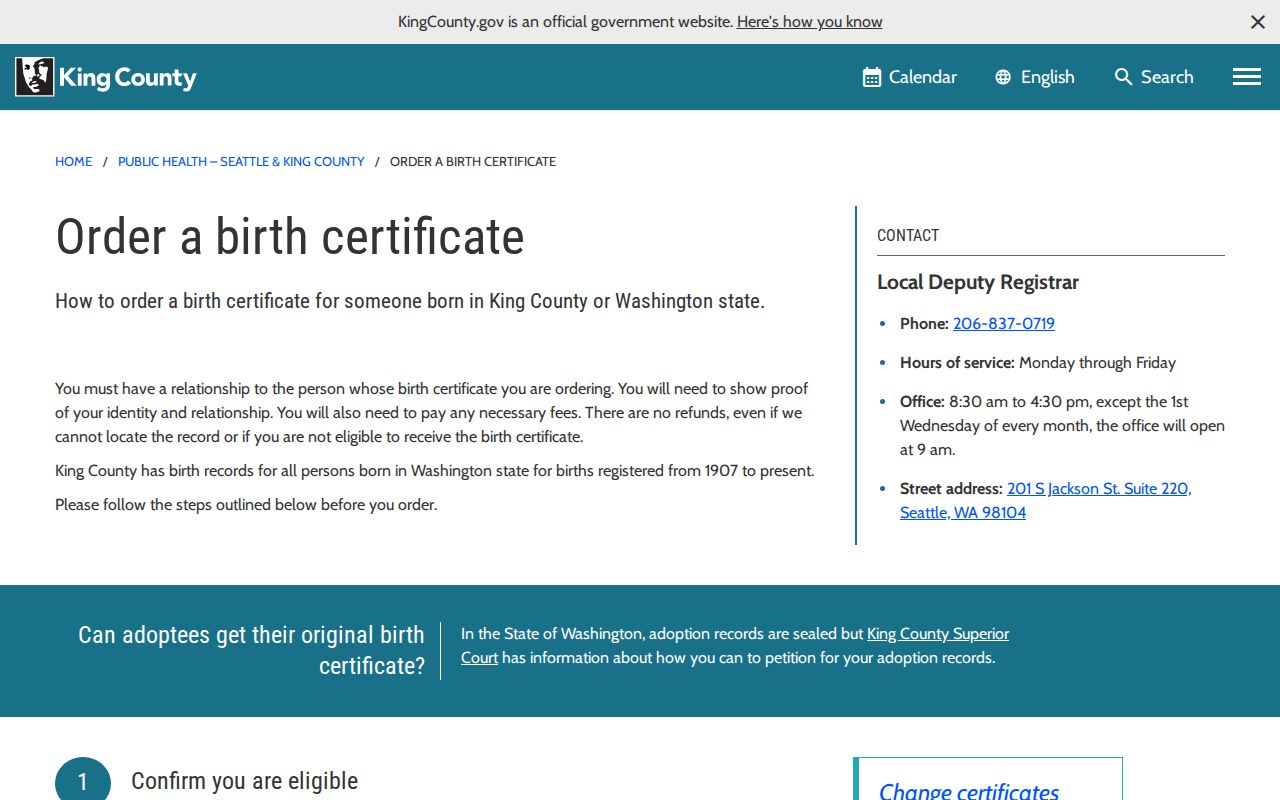
For historical and family research, use Digital Archives and county indexes first, then order certification only when a legal copy is needed.
Sammamish People Search Changes at the 1999 Boundary
Sammamish incorporated in 1999, so the date of an event changes which office may hold the file. Pre-incorporation permits generally belong with King County. Later plans and permits may appear in MyBuildingPermit, the city's Development Activity Map, Engineering Records Vault, or a city records request. Klahanie's 2016 annexation adds another custody transition.
Postal names do not always track city boundaries. A Klahanie address may retain an Issaquah label, while northern neighborhoods often have Redmond ties. Historical work should also try Inglewood, Pine Lake, Beaver Lake, Sahalee, Monohon, and Weber Point. This geography explains why a search limited to the modern city name can miss the right person.
Note: City intersection cameras do not record video, so the city has no camera footage to supply for collision investigations or citation disputes.
Sammamish People Search in Permits and Projects
MyBuildingPermit can connect a property to owners, applicants, contractors, architects, and project dates when those fields appear in the record. Open Advanced Search, select Sammamish as the jurisdiction, and enter the address or parcel number. Public attachments may sit elsewhere, so use a city request for a specifically named plan or file that is not displayed.
City records also include meeting minutes, staff reports, hearing-examiner decisions, commission rosters, ordinances, and resolutions in CivicWeb. These can place a person in a public role or proceeding. They do not create a general resident list, and the city need not make a new report from raw facts just because a requester asks.
Check Sammamish Voter Records Without Guesswork
VoteWA is a personal registration tool, not an open stranger-name index. It uses the registered first and last name plus date of birth to return registration status, address, districts, ballot status, and election information. Washington has no party registration, and participation history never shows a ballot choice.
Protected Records Voters use a special paper process rather than the ordinary online change route. The detailed confidentiality and statewide extract rules are on the Sammamish voter records page.
The King County Elections office is the local route for registration help and election administration, while statewide voter-database extract requests follow Secretary of State rules.
Sammamish People Search in Business and License Indexes
The Secretary of State's CCFS index identifies business entities, registered agents, governors, status, addresses, and filing history. Department of Revenue tools add trade-name and business-license information, while DOH, DOL, L&I, and other boards publish credential status and discipline within their fields. Entities inactive more than ten years may require Washington Digital Archives.
Washington Unclaimed Property is another official name-first source. A match can preserve a reported owner and address connection, but it does not prove where that person lives now. Claims should go through the state process, never through an unsolicited demand for an advance fee.
Sammamish Custody Records Need Status and Context
The King County jail lookup covers current custody and can show a subject name, booking number, facility, booking date, charges, bail, and court information. Washington DOC searches statewide incarcerated people by name or DOC number. The state offender registry supports name and geographic searches but usually does not publish Level 1 registrants.
These records are time-sensitive. An arrest or charge is not a conviction, a jail result can change after release or transfer, and a registry warning may limit use of the data. Ask the correct agency for the current record when identity or status matters.
Sammamish People Search Beyond the Modern City Name
King County Library System databases and microfilm extend a Sammamish people search into census, newspaper, immigration, military, and family-history sources. Ancestry Library Edition requires in-library use. Bellevue Library holds verified Sammamish Valley News microfilm for July 1965 through September 10, 1980 and 1987 through 1989, plus broader Eastside and Seattle runs.
In 1901 a Polk business directory listed Inglewood with a population of 25. A 1913 gazetteer described “Sammamish” as a railroad flag station near Weber Point. Those finds do not establish a continuous city-directory run. They show why old place names, county land files, news reels, and census geography matter more than expecting a modern Sammamish heading.
Sammamish Library expanded to seven-day service in April 2025, which adds access time for in-library genealogy research. Exact local reverse-directory, yearbook, and obituary-index holdings were not published, so search the catalog and ask a Sammamish or Bellevue librarian rather than assuming a title or year exists.
Compare Sammamish People Search Evidence
Commercial finder results can group names, phones, emails, addresses, and possible relatives quickly, but their source dates and identity matching may be unclear. Official records are narrower. A deed identifies parties to an instrument; a parcel roll identifies a taxpayer; a docket identifies case roles; and a license index identifies a credential. None alone is a full personal profile.
| Source type | Best use | Check before relying |
|---|---|---|
| Commercial finder | Broad lead discovery | Source date and same-name mixups |
| Official online index | Locate a record number or public status | Coverage years and omitted fields |
| Watermarked image | Read an unofficial recorded copy | Whether certification is required |
| Custodian copy | Obtain the official file or seal | Fees, exemptions, and eligibility |
Record dates, party roles, and jurisdictions are the best safeguards against false matches. For a past address, compare the assessment year with the deed recording date. For a court result, obtain the named docket item. For genealogy, distinguish a contributed tree from an archive image or certified certificate.
Good source control also means recording where each fact came from. Save the portal name, search date, record number, and the exact party role. A grantor sold or transferred an interest, while a grantee received one. A taxpayer receives the assessment notice but may not hold title in an individual name. A court participant may be a petitioner, respondent, witness, or representative. Those distinctions prevent a loose name match from becoming a false claim about the person.
When two results appear to describe the same Sammamish resident, compare middle names, associated parcels, event dates, and jurisdictions before joining them. A current phone or email result can help reconnect with someone, but use it as a lead. The dated government record supplies a firmer point in time. For an older trail, add newspapers, census schedules, archive descriptions, and probate documents one at a time, noting which facts are indexes and which come from images.
Certification is a separate decision. Family research may need only a readable image, while a court, estate, or agency process may demand a clerk or recorder seal. Asking the recipient first can save both time and copy charges. It also keeps the request narrow enough for the custodian to locate and deliver the correct item.